EDGE Grant AI Chatbot: A Practical Guide for SMEs
 Darrel Liew · CEO and co-founder, Cortex Lab AI · Updated
This guide explains how a Singapore SME (small or medium-sized enterprise) can fund an AI chatbot with the EDGE Grant, the scheme that replaced the Productivity Solutions Grant (PSG) on 30 September 2026. It covers the two EDGE activities a chatbot can fall under, what each one pays, what you must not do before you apply, and how the grant interacts with the 400% AI tax deduction. For every AI grant open to SMEs, start with our guide to AI grants after PSG. This article goes deeper on chatbots only.
Take an example: an eight-person aircon servicing firm that gets most of its bookings on WhatsApp. Staff answer the same price and area questions all day, and a customer waiting for a quote is messaging other firms at the same time. It wants a chatbot that quotes standard servicing prices, confirms which areas it covers, takes booking requests and passes everything else to a person.
Cortex Lab AI builds WhatsApp chatbots for Singapore startups and SMEs.
Can the EDGE grant pay for an AI chatbot?
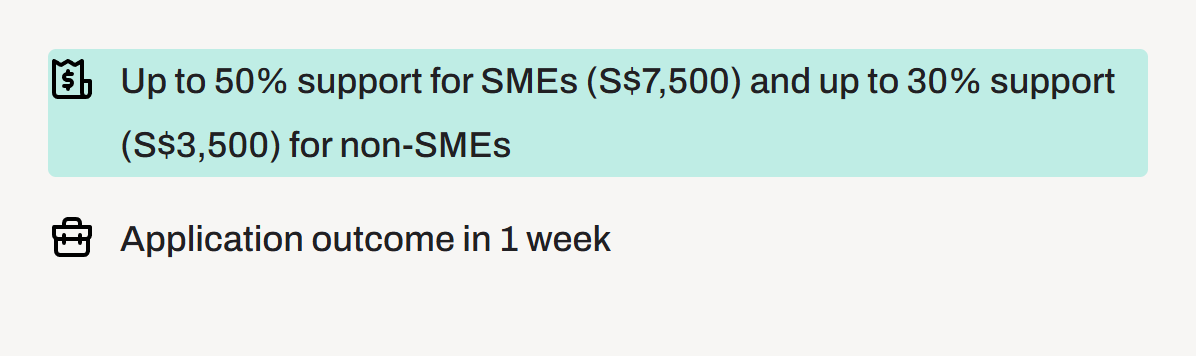
Yes, through one of two activities under Automation & Digitalisation. The GenAI (generative AI) Customer Engagement Chatbot activity pays up to 50% of a pre-approved chatbot package for SMEs, to a maximum of S$7,500. Large-scale Digital Transformation pays up to 50% of a wider project, with a vendor you choose, when the chatbot is one part of a change that connects several systems.
A chatbot built on its own by a vendor that isn't on the pre-approved list fits neither. It isn't a listed package, and Large-scale Digital Transformation excludes "Automation of isolated tasks without broader business transformation". That leaves a lot of chatbot projects outside EDGE, and not every vendor mentions it.
EDGE as a whole covers 8 business areas and over 150 activities. It pays up to 70% for SMEs and up to 50% for non-SMEs, depending on the activity, and caps grant support at S$100,000 per company per year. The cap resets on 1 April. Your business must be registered and operating in Singapore with at least 30% ownership by Singaporeans or Singapore permanent residents (PRs). The EDGE FAQ counts you as an SME if your group's annual sales are no more than S$100 million or it employs no more than 200 workers.
The FAQ also says the applicant "must be a business entity registered in Singapore", and that applications from non-profits, societies, religious bodies, voluntary welfare organisations and statutory boards will be rejected. The EDGE FAQ does not say whether sole proprietorships qualify, so ask EnterpriseSG before you build a package.
What happened to the PSG chatbot grant?
The Productivity Solutions Grant (PSG) has closed, and pre-approved GenAI chatbots are now funded through EDGE's GenAI Customer Engagement Chatbot activity. EnterpriseSG's EDGE page says "EDG, MRA and PSG ceased on 29 September 2026. From 30 September onwards, apply for business grant support under the EDGE Grant." The EDGE FAQ describes EDGE as bringing those three schemes, PSG plus the Enterprise Development Grant (EDG) and Market Readiness Assistance (MRA), into a single grant.
If you applied under PSG before 30 September 2026, the FAQ says your application "will continue to be assessed based on the requirements of the relevant scheme", and ongoing projects are supported until completion and claim payout. Money you received under PSG doesn't count towards the EDGE caps. A project PSG already funded shouldn't go in again under EDGE. Our guide to the switch from PSG to EDGE covers the full changeover.
What is the GenAI Customer Engagement Chatbot activity?
It's the pre-approved EDGE route for chatbots. EnterpriseSG's activity page sums it up in one sentence: "Chatbots automate customer enquiries on digital platform and enhance engagement through personalised recommendations." You buy a package listed on SMEs Go Digital, the list of pre-approved vendors and packages kept by IMDA (the Infocomm Media Development Authority), and the grant pays part of the software cost.
| What | Grant terms |
|---|---|
| SMEs | Up to 50%, at most S$7,500 |
| Non-SMEs | Up to 30%, at most S$3,500 |
| Most cost counted | S$15,000 |
| Covers | Software, up to 12 months |
| Not covered | GST and maintenance |
| Vendor | Listed on SMEs Go Digital |
| Documents | Quotation, 1-year savings projection |
| Annual limit | Inside the S$30,000 digital cap |
| Decision in | 1 week |
| Deadline | 18 months from approval |
| Repeat funding | Not for the same product |
| Claim | Photo of the software and its ID |
| Payout | 14 working days by PayNow |
The digital cap is the S$30,000 limit for all Automation and Digitalisation projects, inside the S$100,000 EDGE cap. The cost-savings projection covers the year after the project ends, the ID is the software's unique identifier, and payout by GIRO bank transfer instead of PayNow Corporate takes up to 8 weeks.
For non-SMEs, 30% of S$15,000 would be S$4,500, so the S$3,500 on the page is the lower figure to plan around.
Applying works like this, per the page. You pick a vendor and package from the SMEs Go Digital list, get the vendor's quotation, build a matching package on SMEs Go Digital, and sign in with your company's Corppass (the government login for businesses) to generate a package reference ID. Then you apply on the Business Grants Portal. You have to do this yourself, and the page says "Third-party companies are not permitted to apply for or manage the grant on behalf of the applicant company."
The package builder on SMEs Go Digital is where you adjust the variable parts of a listed package. The EDGE FAQ gives staff numbers, implementation period and training as examples. The activity page says the package you build "should match the vendor quotation exactly", so settle the quotation first. The FAQ limits selected single-function digital solutions to one application per UEN (Unique Entity Number, the business's registration number), and doesn't say which.
- Is the business registered and operating in Singapore, at least 30% owned by Singaporeans or PRs?No Not eligible for EDGE.
- Has work started, or have you paid a deposit?Yes The application would be retrospective, and EDGE doesn't fund that.
- Is the vendor connected to your business or its related companies?Yes The EDGE FAQ bars that supplier.
- Is the package listed on SMEs Go Digital?No This activity doesn't apply. Check Large-scale Digital Transformation.
- Get the vendor's quotation
- Build the matching package on SMEs Go Digital
- Sign in with Corppass to generate a package reference ID
- Apply on the Business Grants Portal yourself
- Get the outcome in 1 week, then sign and pay
- Complete the project within 18 months of approval
- Claim with a photo of the deployed software and its unique identifier
- Paid within 14 working days of claim approval by PayNow Corporate, or up to 8 weeks by GIRO
How much would EDGE pay towards the aircon firm's chatbot?
On the example quote below, S$6,000. EDGE pays up to 50% of the software line only, so the firm still pays S$9,200 of the S$15,200 total before GST.
| Line in the quote | Amount | Grant |
|---|---|---|
| Software, 1 year | S$12,000 | S$6,000 |
| Setup | S$2,000 | S$0 |
| Maintenance | S$1,200 | S$0 |
| Total before GST | S$15,200 | S$6,000 |
Setup here means loading prices, service areas and booking questions. Software is the only cost the activity page lists as supported, so setup gets nothing, and maintenance is excluded outright. If a vendor tells you setup is covered, ask them to show you where EnterpriseSG says so. The figures are an example; our AI chatbot cost guide has vendors' published price ranges.
The S$15,000 cost cap limits bigger packages. If the software line were S$20,000, the grant would still stop at S$7,500. The S$6,000 also uses up part of the firm's S$30,000 Automation and Digitalisation cap until 1 April, so any other digital project it wants funded in the same grant year has S$24,000 left to draw on.
When does Large-scale Digital Transformation fit a chatbot project?
When the chatbot is one part of a project that connects or standardises several systems. The activity page asks for projects that "Strengthen core business operations using modern technologies such as cloud-based enterprise platforms, data analytics and visualisation, AI/ML, RPA, or workflow automation", with "integration and/or standardisation efforts across systems such as business, sales, and procurement". AI/ML means artificial intelligence and machine learning, and RPA is software that repeats routine clicks and typing. It pays up to 50% for SMEs and up to 30% for non-SMEs. There's no pre-approved list, so you choose the vendor.
A chatbot that only answers the aircon firm's questions would not fit. A project where the WhatsApp bot takes a booking, checks which technician is free, creates the job in the firm's job management software and raises the invoice in its accounting software is closer to what the page describes. That kind of connecting work is what our AI integration service covers. Whether a project like that qualifies is EnterpriseSG's decision on the application.
This route asks a lot more of you than the chatbot activity.
- Documents: a project proposal, vendor proposals and quotations, and audited or management-certified financial statements for the last financial year. You also project revenue growth, cost savings and overseas sales (if applicable) for 3 years after the project ends, and new jobs paying a gross monthly salary above S$5,000 for 1 year after it ends.
- What you submit at the end: a project report with milestones and benefits, a demonstration with screenshots and photos of the deployed software, training records where applicable, and a final consultancy report.
- Claim: before you claim, you engage an audit firm from EnterpriseSG's Panel of Auditors and sign its engagement letter.
- Not covered: isolated task automation, basic IT upgrades, GST and maintenance.
The word "Large-scale" is a fair warning for an eight-person firm. The page sets no minimum project size, but the paperwork is written for a substantial project. If your plan doesn't change how several parts of the business run, this is probably the wrong route.
Which route fits your chatbot project?
Settle the route before you compare vendors on price.
| Your project | EDGE route |
|---|---|
| Listed package, fits as is | Chatbot route |
| Listed package, needs changes | Chatbot route, with care |
| Custom bot on its own | Neither |
| Bot inside a cross-system project | Large-scale route |
| Work started or deposit paid | Neither |
The chatbot route is the GenAI Customer Engagement Chatbot activity, with an outcome in 1 week. If a listed package means changing how you take bookings, the grant still covers the software, but the time spent changing your process isn't covered. A custom or configured bot on its own, from a vendor not on the list, isn't a listed package and is too narrow for Large-scale Digital Transformation. A bot that is one part of connecting your sales, operations and finance systems matches the large-scale route's cross-system scope, if EnterpriseSG agrees. Work already started, or a deposit paid, makes the application retrospective, meaning work began before you applied, and EDGE doesn't fund that.
EnterpriseSG's EDGE page also points businesses to its BizSG recommender to match a project to an activity.
What if your chatbot vendor isn't listed?
Then the chatbot activity can't fund that vendor. The EDGE FAQ's answer for a solution that isn't pre-approved is to check EnterpriseSG's list of supported activities and, if none fits, approach an SME Centre for help. The FAQ describes a use-your-own-vendor option for Integrated ERP, a different activity, with processing of about 10 weeks against about one week for a pre-approved vendor. It describes no such option for the chatbot activity.
Two rules hold whichever way you go. EDGE won't support expenses that EnterpriseSG or another agency has already approved a grant for. And a bot you buy outright, with no grant, may still qualify for the 400% AI tax deduction covered below.
What order do you have to do things in?
Apply before any work starts or any money changes hands. The EDGE FAQ says "Businesses must not have started work or made any payment or deposit to a supplier, vendor, or third party prior to application submission." It adds: "Retrospective applications will not be supported."
Once you've submitted, you may buy before approval. The FAQ says "Payment made after the application submission date may be supported if the application is subsequently approved", and that the company bears the risk of anything it commits to before approval. On the chatbot activity the outcome takes 1 week, so waiting costs little.
For the aircon firm on the chatbot route:
- Count how many WhatsApp enquiries arrive each week and how long staff spend answering them. That's the baseline you'll judge the bot against later.
- Shortlist listed packages on SMEs Go Digital and ask each vendor for a demo using the firm's real customer questions.
- Get a written quotation with software, setup and maintenance on separate lines.
- Build the matching package on SMEs Go Digital and generate the package reference ID through Corppass.
- Apply on the Business Grants Portal yourself. No deposit and no work before this. The FAQ doesn't mention contracts, but we'd hold off signing as well.
- Wait the week for the outcome, then sign and pay.
- Complete the project within 18 months of approval.
- Claim with the photo of the deployed software and its unique identifier. The money arrives within 14 working days after claim approval by PayNow Corporate, or up to 8 weeks by GIRO.
You can't swap vendors after you submit. The FAQ allows changes only to the project end date and the claim due date. Our broader EDGE grant guide covers the full sequence for both routes.
How does EDGE work with the 400% AI tax deduction?
Both can apply to the same project, but never to the same dollars. Under the Enterprise Innovation Scheme (EIS), IRAS gives a 400% tax deduction on the first S$50,000 of qualifying AI expenditure each Year of Assessment (YA, the tax year IRAS assesses), for YA 2027 and YA 2028. The IRAS e-Tax Guide says the qualifying amount "excludes any expenditure subsidised by a grant or subsidy from the Government." The share EDGE pays never qualifies. The share you pay yourself may.
What qualifies, per Annex F of the guide:
- Subscribing to or licensing an AI system. IRAS lists "Conversational AI and generative language models" among its examples.
- Services that support the development, deployment, operation or maintenance of an AI system, including system development, consultancy and strategy, and training on the system.
- Not physical infrastructure or hardware, such as servers and computing equipment.
If a package mixes AI features with ordinary software, such as a booking calendar, only the AI part qualifies, and you split the cost between the two on a reasonable basis (Annex F, para 3.2). There's also no cash payout for this category (Annex F, para 4.1), so the deduction only helps against taxable income. Any excess is treated as an unutilised trade loss, which can usually be carried forward to later years.
In the example. The aircon firm paid S$9,200 itself: S$6,000 of software after the grant, S$2,000 of setup and S$1,200 of maintenance. If all of it relates to the AI system, it could claim a deduction of up to S$36,800, which is 400% of S$9,200. If part of the package is ordinary booking software, the qualifying amount is smaller. Setup and maintenance may count as services for deploying and maintaining an AI system, but that's for your accountant to confirm.
For a company whose financial year runs January to December, YA 2027 covers spending in 2026 and YA 2028 covers spending in 2027. The guide as published doesn't extend the AI deduction beyond YA 2028.
What happens when the 12 months of grant-supported software end?
You pay the whole subscription from month 13. The chatbot activity supports software costs for up to 12 months, and its conditions say you must "Not have previously applied for grant support for this solution". Read plainly, that rules out a second application for the same chatbot next year, and the EDGE FAQ limits selected single-function digital solutions to one application per UEN. Budget for year two without the grant.
For the aircon firm, year two means another S$12,000 of subscription in the example, plus maintenance, all self-funded. The AI share of that may qualify in full for the 400% deduction, provided the spending counts towards YA 2028. For a January to December financial year, that means spending in 2027.
The EDGE pages also say nothing about channel fees. On the WhatsApp Business Platform, often called the WhatsApp Business API, Meta charges for each message it delivers. Since 1 October 2026 that includes replies sent in the 24 hours after a customer messages you, at S$0.0205 each on Meta's Singapore-dollar rate card, once a number has used its 1,000 free replies for the month. A bot that only answers incoming questions may stay inside that allowance. One that sends booking reminders will run up more. The EDGE pages don't say whether those charges count as software, so assume they don't until EnterpriseSG says otherwise. Our WhatsApp Business API pricing guide works through the Singapore rates.
What can go wrong with a grant-funded chatbot?
- It gets an answer wrong. It will, occasionally. The grant pays for the software and nothing after that. Before the bot goes live, decide which questions go straight to a person. For the aircon firm, that's quotes for new units, complaints, refunds and anything about a leak. The bot should tell the customer a staff member will reply, and roughly when.
- It doesn't know. A properly set-up bot says so and hands over instead of guessing. In the demo, ask it a question it hasn't been given the answer to and see what happens.
- Nobody picks up the handover. If staff only see handed-over chats in the evening, customers wait longer than before the bot existed. Name who covers handovers in working hours and what happens outside them.
- The vendor is connected to you. The EDGE FAQ bars suppliers that have any relationship, connection, association or dealings with the applicant or its related companies.
- The application is rejected. If you waited for the outcome, you've lost a week. You can still go ahead unfunded, and all of the AI spend may then qualify for the 400% deduction.
- The vendor folds or underdelivers. You can't change vendors on an application. Ask EnterpriseSG before you engage a replacement, because a new application for half-finished work may count as retrospective.
- Customer data goes somewhere you didn't expect. The bot will see names, addresses and phone numbers, and the grant doesn't check how the vendor stores them. Our PDPA checklist for AI chatbots covers what to ask under the PDPA, Singapore's data protection law.
What should you ask a chatbot vendor before applying?
- Is this package listed on IMDA's SMEs Go Digital under the GenAI Customer Engagement Chatbot activity, and can you show me the listing?
- Which lines of the quote are software, which are setup, and which are maintenance or other ongoing fees?
- What does year two cost, after the 12 months of grant-supported software?
- Are WhatsApp or other channel message charges included, and who pays them?
- Will you wait until I've submitted the application, and ideally until it's approved, before starting work or taking a deposit?
- What does the bot do when it doesn't know an answer, and how does the handover reach my staff?
- Where is customer data stored, who can see it, and is it used to train any model?
- Can I update the bot's answers myself when prices change, or do I pay you each time?
- How much of the package is an AI system, so my accountant can split the cost for the EIS deduction?
- Which number should improve after the bot goes live, and how will we both measure it?
Do you need the EDGE grant for a chatbot at all?
Often not. On the example quote, the grant saves S$6,000 in year one and nothing after that. If a cheaper product that isn't on the list answers your customers' questions well, buying it outright can cost less than a pricier listed package at half price. Kai Dojo, our WhatsApp assistant, costs S$149 a month, all in, on a 12-month package, about S$1,788 a year, and our team sets it up and tunes it on your real conversations.
Go without the grant if any of these apply:
- Your business has less than 30% Singaporean or PR ownership, so it isn't eligible.
- The bot you want isn't a listed package and isn't part of a wider project.
- You've already paid a deposit or work has started.
- The chatbot only pays off at half price. Look for a smaller version that pays off on its own.
Below about ten enquiries a day, start with the WhatsApp Business app's free away messages and quick replies. A chatbot pays off once enquiries grow past what staff want to retype.
Where Cortex Lab AI fits
Kai Dojo is our done-for-you WhatsApp assistant for Singapore startups and SMEs, from gyms and salons to clinics and tuition centres. It costs S$149 a month, all in, on a 12-month package, about what a chatbot tool you set up yourself costs. We set it up from your real conversations and tune its instructions weekly in the first month. The AI model is never trained on your customers' chats. It answers your customers' common questions and hands the harder ones to your staff. For the aircon firm, that means price and area questions answered in seconds, and new-unit quotes, complaints and leaks passed to a person. Meta's per-message fees are the only extra. We're a Singapore team and we follow the PDPA.
For a bot that is one part of connecting your booking, job and accounting systems, we can help you scope the project before you apply. Bring last month's enquiries to a free 30-minute consultation and we'll show you how Kai Dojo would handle them.
Frequently asked questions
Can I use the EDGE grant for an AI chatbot?
Yes, if you buy a pre-approved package through the GenAI Customer Engagement Chatbot activity, or if the chatbot is part of a cross-system project that qualifies under Large-scale Digital Transformation. A standalone bot from a vendor that isn't on the pre-approved list fits neither.
How much does EDGE pay for a GenAI chatbot?
Up to 50% for SMEs, to a maximum of S$7,500, on a cost capped at S$15,000. Only software costs for up to 12 months are supported. GST and maintenance are not.
Can I choose any vendor for an EDGE-funded chatbot?
Not on the chatbot activity, which needs a pre-approved vendor and package from IMDA's SMEs Go Digital list. Large-scale Digital Transformation lets you choose your vendor, but the project must involve integration or standardisation across several systems.
Does EDGE cover WhatsApp message charges?
The EDGE page, FAQ and chatbot activity page don't mention them. The chatbot activity supports software costs only, so plan on paying Meta's message charges yourself unless EnterpriseSG confirms otherwise.
Can I claim the 400% AI tax deduction on an EDGE-funded chatbot?
On the share you paid yourself, possibly. IRAS excludes spending subsidised by a government grant, so only your share can qualify, up to S$50,000 of qualifying AI expenditure per Year of Assessment for YA 2027 and YA 2028.
Can I apply again when the first 12 months end?
Probably not for the same product. The chatbot activity requires that you have not previously applied for grant support for that product. Ask EnterpriseSG before you plan a second application.
Sources: checked 16 October 2026, EnterpriseSG EDGE Grant; EDGE Grant FAQ; EDGE GenAI Customer Engagement Chatbot. Checked 5 October 2026, EDGE Large-scale Digital Transformation; IRAS e-Tax Guide, Enterprise Innovation Scheme, third edition, published 31 August 2026; Meta, WhatsApp Business Platform pricing.